Credit
AI Builders Fall; One Holds Out for Payment Terms
Comfort Systems, down 9.26 percent Friday, has not signed long-term modular deals with a frontier AI lab or colocation firms, holding out for commitments and payment terms.
HOUSTON, Oct. 23 — Comfort Systems USA, a Houston contractor, earns most of its revenue from technology customers such as data centers. On Friday its executives said it was building modules for a frontier AI lab and for colocation providers but had not yet agreed on terms for the long-term arrangements it calls “programmatic.”
“The reality is, we haven’t yet reached terms where we’re willing to accept business from these people,” Bill George, the chief financial officer, said on the call, according to a transcript published by Investing.com. One thing “front and center,” he said, is “the ability to pay.” He added: “Not that these people don’t have financial strength, because they do.”
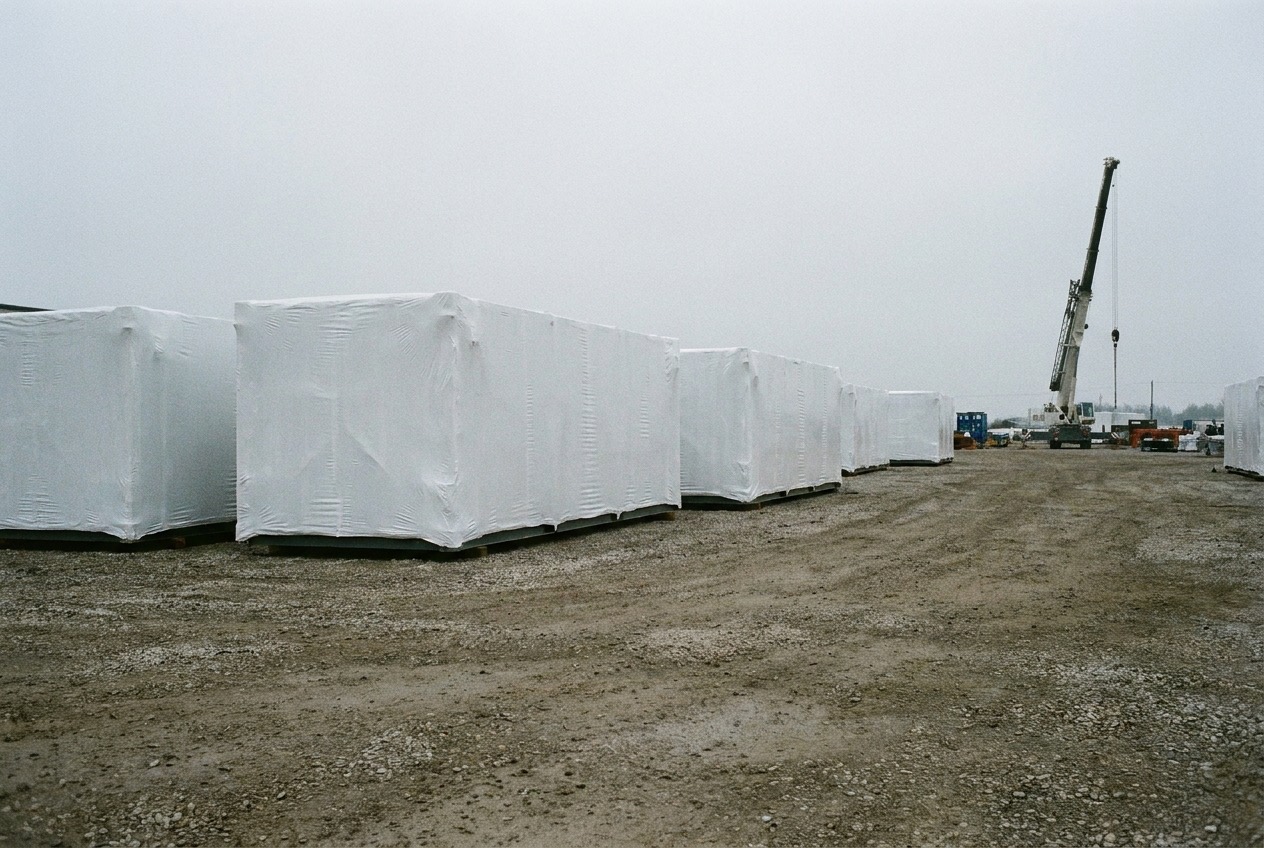
Comfort continues “to explore deeper partnerships” with them, said Trent McKenna, the president. Its programmatic customers, two big ones, have typically made five-year volume commitments, Mr. George said, before Comfort spent heavily on space to build their product; in modular work, it gets payments at mobilization and on delivery.ModularComfort builds parts of a data center’s plant, such as hot-aisle containment and chiller plants, in its own facilities and ships them to the site.
Comfort’s shares fell 9.26 percent on Friday, to $1,160.86, and 19.33 percent on the week. Bloom Energy, whose fuel cells generate electricity at a customer’s site, fell 11.24 percent, to $193.30. CNBC said Comfort’s margins had come in below expectations and that, at Bloom, what “stirred fear among investors was the reported negative free cash flow for the quarter.”
Behind both quarters is a question for the suppliers of the AI build-out: on what terms, and how soon, they are paid. Comfort is being paid. Its free cash flow was $805.6 million in the quarter, by its own measure; Mr. George credited “advantageous payment terms and favorable collections from large technology customers,” and $166 million of income taxes deferred to the fourth quarter.
For one wafer plant, a building he said would be “pretty useless to anybody but the person building it,” Comfort asked to be paid every two weeks. “There are people rolling into modular now who are taking large books of business who we think are agreeing to payment terms where they are banking on some people,” he said. “If we lose work on that basis, we don’t mind it.”
Demand is not Comfort’s limit. “The governor’s really just labor,” Mr. McKenna said. Brian Lane, the chief executive, said its backlog now runs roughly 18 to 24 months, against about nine months a decade ago, and that no moratorium had delayed its current work. An executive added that “a lot of these data centers is generating their own power anyway.”
That is Bloom’s trade. Bloom’s net income was $249.0 million in the third quarter, but its operations used $27.1 million of cash, after providing $226.4 million in the second quarter, while revenue it had recognized but not yet billed rose by $430.3 million. It spent $153.5 million on property and equipment; by this paper’s arithmetic, its free cash flow was about minus $180.6 million, a figure Bloom’s release does not give. It ended September with about $2.49 billion in cash and equivalents, and raised its forecast for 2026 revenue.
Bloom’s report says its receivables and unbilled revenue grew this year with higher volume, more project activity and “the timing of billing milestones.” Customer deposits rose too, to $661.4 million at Sept. 30 from $78.2 million at the end of 2025. Two customers brought in about 43 percent and 26 percent of its third-quarter revenue; the second is a related party, and Bloom’s related-party sales, $321.6 million in the quarter, are to joint ventures it holds with Brookfield Asset Management.The CustomerBloom’s “customer” is the counterparty it sells to, which “may be a project‑finance affiliate rather than the ultimate end user of the products,” its report says.
CoreWeave, the AI cloud company, closed on Friday at $54.24, down 2.46 percent, its lowest close since May 9, 2025. Morgan Stanley cut its price target to $70 from $99, and its analyst Adam Wood said that “growing financing uncertainty reduces visibility into the path to deploying existing contracted capacity,” CNBC reported. The most reasonable path forward, he said, would likely be through “securing a portion of the financing via a hyperscaler agreement to obtain a more attractive rate.”
UBS also cut its target, to $105 from $120, but kept its buy rating. On Friday CNBC reported that the yield on CoreWeave’s 9.75 percent bond due 2031 stood at 15.637 percent and the spread on its five-year credit-default swaps at 1,129 basis points; a reading above 1,000 basis points, it noted, is generally considered distressed.
In the third quarter Comfort’s operations brought in $1.01 billion of cash, about twice its net income of $489.0 million, while Bloom’s used cash despite a profit. What Comfort looks for in newer buyers, Mr. George said, is “the nature of the commitment and the payment timing.”
The next reports come on Wednesday, Oct. 28, from GE Vernova and Vertiv, before the market opens, and on Thursday, Oct. 29, from the contractors Quanta Services and EMCOR, also before the open.
Sources
- Investing.com, “Earnings call transcript: Comfort Systems USA tops Q3 2026 estimates, shares fall,” Oct. 23, 2026.
- The Motley Fool, “Comfort Systems (FIX) Q3 2026 Earnings Call Transcript,” Oct. 23, 2026.
- Comfort Systems USA (SEC Form 8-K, Exhibit 99.1), “Comfort Systems USA Reports Third Quarter 2026 Results,” Oct. 22, 2026.
- Comfort Systems USA (SEC Form 10-Q), “Quarterly Report for the quarter ended Sept. 30, 2026,” Oct. 22, 2026.
- Bloom Energy (SEC Form 8-K, Exhibit 99.1), “Bloom Energy Reports Record Third Quarter 2026 Financial Results and Raises Full Year 2026 Guidance,” Oct. 22, 2026.
- Bloom Energy (SEC Form 10-Q), “Quarterly Report for the quarter ended Sept. 30, 2026,” Oct. 22, 2026.
- CNBC, “Stocks making the biggest moves premarket: AT&T, SpaceX, Moderna, Deckers, Bloom Energy and more,” Oct. 23, 2026.
- CNBC, “Dow tumbles more than 600 points as oil prices rise and market sell-off hits most sectors (live updates: “Morgan Stanley lowers price target on CoreWeave”),” Oct. 23, 2026.
- CNBC, “Here are Friday’s biggest analyst calls: Nvidia, SpaceX, CoreWeave, Deckers, Unusual Machines & more,” Oct. 23, 2026.
- CNBC, “10-year Treasury yield drops back to 5% this week as investors seek cover from AI worries,” Oct. 23, 2026.
- Yahoo Finance, “Comfort Systems USA (FIX), daily chart data,” Oct. 23, 2026.
- Yahoo Finance, “Bloom Energy (BE), daily chart data,” Oct. 23, 2026.
- Yahoo Finance, “CoreWeave (CRWV), daily chart data,” Oct. 23, 2026.
- Nasdaq, “CoreWeave (CRWV), daily historical closes,” Oct. 23, 2026.
- GE Vernova, “GE Vernova to announce third quarter 2026 financial results on October 28,” Oct. 13, 2026.
- Vertiv, via PR Newswire, “Vertiv Announces Date of Third Quarter 2026 Earnings Release and Conference Call,” Oct. 14, 2026.
- Quanta Services, “Quanta Services Announces Third Quarter 2026 Earnings Release & Webcast Schedule,” Oct. 13, 2026.
- EMCOR Group, via Business Wire, “EMCOR Group, Inc. Sets Third Quarter 2026 Earnings Release Date and Webcast,” Oct. 15, 2026.