The Labs
OpenAI Says GPT-6 Designed a Device Within a Week
OpenAI says GPT-6 Astra designed a gadget’s case, circuit board and firmware in under a week, though it did not always allow for the factory’s limits.
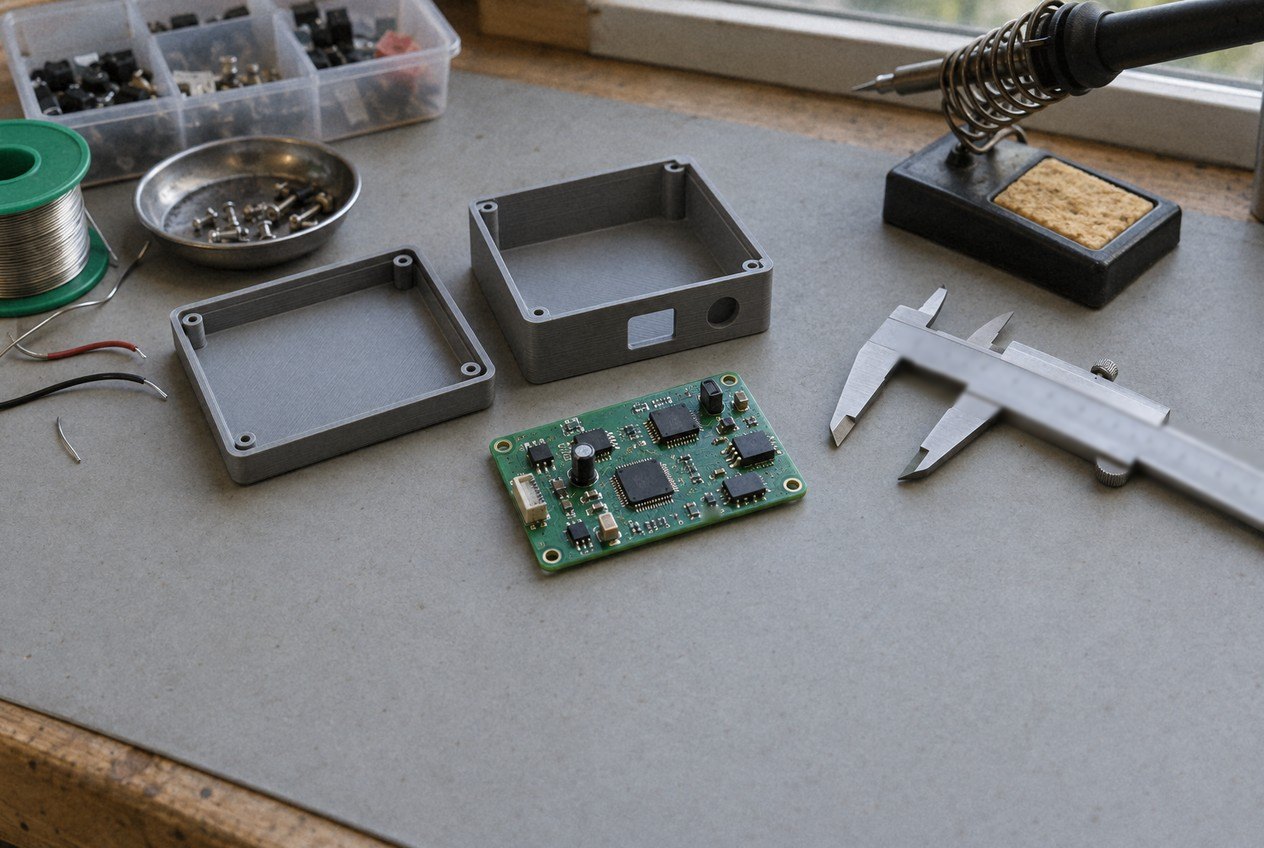
SAN FRANCISCO, Nov. 3 — OpenAI said on Tuesday that its GPT-6 Astra model had designed a small device for talking to Codex, the company’s coding agent: the enclosure, the circuit board and the firmware. Two employees, working on it as a side project, finished the design with the model in under a week, the company said, and a contract manufacturer built a small batch of prototypes in under a month.
The test, as OpenAI set it, was whether it could make a device “without any direct human edits.” GPT-6 defined the functional requirements; Astra chose the electrical components, laid out the board to fit the case, designed the interface and generated the firmware and the software that connects the device to Codex, the company said.The Look, TooOpenAI says Astra also developed the device’s appearance, drawing on the company’s recent collaboration with Work Louder and on “references from games and toys.” It also said where the model fell short. “Getting the device ready for manufacturing still required several rounds of review and iteration,” the company wrote, adding that Astra “did not consistently account for the manufacturer’s production limits, tolerances, or details required for assembly.”
The post is addressed to a market. OpenAI asks engineers, engineering firms and software vendors “involved in the design, simulation, manufacturing, or production of complex physical products” to work with it, and says its models already help its own teams prepare drawings, set up simulations and review designs. Investing.com, writing about a report on Anthropic the same day, said the potential emergence of AI-driven design tools “poses a structural threat” to the market for electronic design automation, the software used to design chips.
OpenAI’s hardware and infrastructure teams use Codex and ChatGPT to create and revise computer-aided design models, in work that spans robotics and computing infrastructure, the company said. “Since February, model usage across our hardware teams, measured in tokens, has grown 23-fold,” it wrote.Not the First ClaimOpenAI’s chief financial officer, Sarah Friar, said in September that the company had used internal systems to design its custom “Jalapeño” chip with Broadcom in nine months, according to Investing.com.
On BenchCAD 2.0, which tests whether models can reconstruct 3D parts and assemblies and identify connections in circuit boards, an unnamed newer internal model averaged 0.875, against 0.594 for Astra at its highest reasoning setting, OpenAI said. The benchmark’s own authors, who thank both OpenAI and Anthropic for API credits, published Astra’s best score as 0.59 out of 1 in October; at maximum effort, on the same 100 cases and the same version of the test, they found Astra and Anthropic’s Claude Opus 5.5, at 0.57, scored “about the same.” OpenAI does not say which version produced its newer model’s 0.875. Their test covers “geometry, part placement and circuit connectivity, not manufacturability or physical performance.” No one outside OpenAI has assessed the device, or the newer model’s score, in what has been published. Apart from a diagram of the enclosure, OpenAI’s post publishes none of the design, and it does not name the newer model or offer access to it.
The company named two outside partners. It is expanding its work with Chip Ganassi Racing, the motor-racing team, on turning 3D scans of existing parts into editable design models and 2D manufacturing drawings, which it says is “particularly useful when the original design files are unavailable.” And it announced a research collaboration with Mazda, whose aerodynamics and crash-safety engineers are working with OpenAI’s research and forward-deployed engineering teams on how its models can help develop and evaluate new vehicle designs. “We’ll share more progress and results in the coming months,” OpenAI wrote.
The Other Lab
Anthropic is making a related claim, to investors. Investing.com, summarizing a report by The Information, said on Tuesday that Anthropic had told prospective investors in its initial public offering that “its newly formed 15-person hardware unit is deploying Claude models to accelerate custom silicon development”; Techmeme’s summary of The Information’s report attributes it to sources. Investing.com also wrote that Anthropic “has reportedly approached several EDA firms seeking access to proprietary chip design datasets,” and that it has not articulated plans to sell Claude’s chip-design abilities to others.
Investing.com reported that shares of Synopsys fell 2.5 percent and Cadence Design Systems 4.5 percent “in Tuesday trading,” in a story Yahoo Finance shows as posted at 10:35 a.m. Eastern time. By the close the declines were smaller: Synopsys ended Tuesday at $462.88, down 0.7 percent, and Cadence at $323.75, down 1.7 percent, according to Yahoo Finance.
Neither the device nor the reported chip work has been tested by outsiders in what has been published. The next measures are OpenAI’s promised results from Mazda, and whether the internal model behind the 0.875 is released.
Daily Cortex is written with AI models, including Anthropic’s Claude, and fact-checked with OpenAI’s GPT models.
Sources
- OpenAI, “Accelerating engineering for the physical world,” Nov. 3, 2026.
- BenchCAD, “Introducing BenchCAD 2.0,” Oct. 12, 2026.
- OpenAI, “Codex.”
- The Information, “Anthropic Touts Claude’s Chip Design Skills to IPO Investors,” Nov. 3, 2026.
- Investing.com (via Yahoo Finance), “Anthropic touts Claude’s chip design skills to investors ahead of IPO, report says,” Nov. 3, 2026.
- Techmeme, “Techmeme’s summary of The Information: “Sources: Anthropic has told investors in recent meetings that its 15-person chip design team is using Claude…,” Nov. 3, 2026.
- Yahoo Finance, “Synopsys (SNPS), daily prices,” Nov. 3, 2026.
- Yahoo Finance, “Cadence Design Systems (CDNS), daily prices,” Nov. 3, 2026.