The AI Trade
SpaceX’s AI Turns a Profit; Spending to Nearly Double
SpaceX’s AI segment made an operating profit of $431 million on $7.56 billion of revenue; SpaceX expects capital spending of $35 billion to $40 billion this quarter.
STARBASE, Tex., Oct. 20 — SpaceX’s artificial intelligence business turned a profit in the third quarter. In the fourth, SpaceX expects to nearly double its capital spending as more of its computing capacity comes online.
The segment, which SpaceX now calls Super Intelligence, had an operating profit of $431 million on revenue of $7.56 billion, more than nine times its revenue a year earlier, the company reported on Tuesday after the market closed.Super IntelligenceSpaceX’s new name for the segment it previously reported as Artificial Intelligence. It spans Grok, the social network X and a data-center business, Reuters notes; xAI merged with SpaceX in February. On the call with investors that followed, Bret Johnsen, the chief financial officer, said capital spending this quarter would be $35 billion to $40 billion, against $19.6 billion in the third.
By SpaceX’s account, demand for AI computing is still running ahead of supply: at current prices new capacity pays for itself in less than a year, Mr. Johnsen said, and Elon Musk, the chief executive, said SpaceX could rent out its computing “several times over.” That cuts against a fear that has hung over the companies that rent out computing. CoreWeave and Nebius, two of them, were down 28 percent for October as of Tuesday, CNBC reported, on concerns that rising interest rates would make their costly buildouts a financial burden. Truist Securities called SpaceX’s quarter “the first data point during the earnings season to support the bull case for AI cloud providers,” in a note quoted by CNBC.
Much of SpaceX’s spending goes to the makers of chips, servers and power equipment. SpaceX is paying for it with the $85.7 billion its June stock offering raised, with cash from its operations and, more and more, with borrowing.
The Quarter
SpaceX’s revenue rose 161 percent to $14.58 billion, against the $12.72 billion analysts expected, according to LSEG data cited by Reuters and CNBC, and the Super Intelligence segment supplied more than half of it. Net income was $4.4 billion, against a loss of $1.05 billion a year earlier and the $1.57 billion profit analysts expected, Reuters reported. Operating income was $2.79 billion; the rest came from $873 million of interest income, $1.03 billion of other income and a $390 million tax benefit, less $675 million of interest expense.
SpaceX credited the segment’s growth to “the activation of new cloud services agreements, the acquisition of Cursor, and increased Grok adoption across enterprise customers and consumers.” Cursor, an AI coding company it bought on Aug. 14 at an implied equity value of $60 billion, added $608 million of revenue by Sept. 30.What Cursor CostsSpaceX put the accounting purchase price at $42.5 billion. Equity awards worth $23.4 billion, tied to Cursor employees’ future service, are to be charged as compensation over roughly three years, Mr. Johnsen said.
The segment’s profit came after $1.2 billion of share-based compensation from the Cursor deal; without it, Mr. Johnsen said, the segment made $1.6 billion. It had lost $1.26 billion in the second quarter and $1.72 billion a year earlier. In its prospectus in June, SpaceX warned that the segment “has incurred significant operating losses since inception, and we may not achieve profitability in this segment, or, if achieved, sustain it.”
SpaceX’s release names no AI computing customers. CNBC and Reuters have reported that it rents capacity to Anthropic, Google and Reflection AI. Starlink is still the bigger earner: the connectivity segment made $2.37 billion from operations on revenue of $5.25 billion, up 69 percent.
The Spending
The cost runs well ahead of the revenue: the Super Intelligence segment’s capital spending, $16.4 billion, was more than twice its revenue and 84 percent of SpaceX’s total. That total, $19.6 billion, was almost exactly the $19.61 billion Bloomberg consensus that Pepperstone cited before the report. SpaceX ended September with 1.7 gigawatts of nameplate computing capacity, up from 1.4 gigawatts at the end of June and 0.6 gigawatts a year earlier.
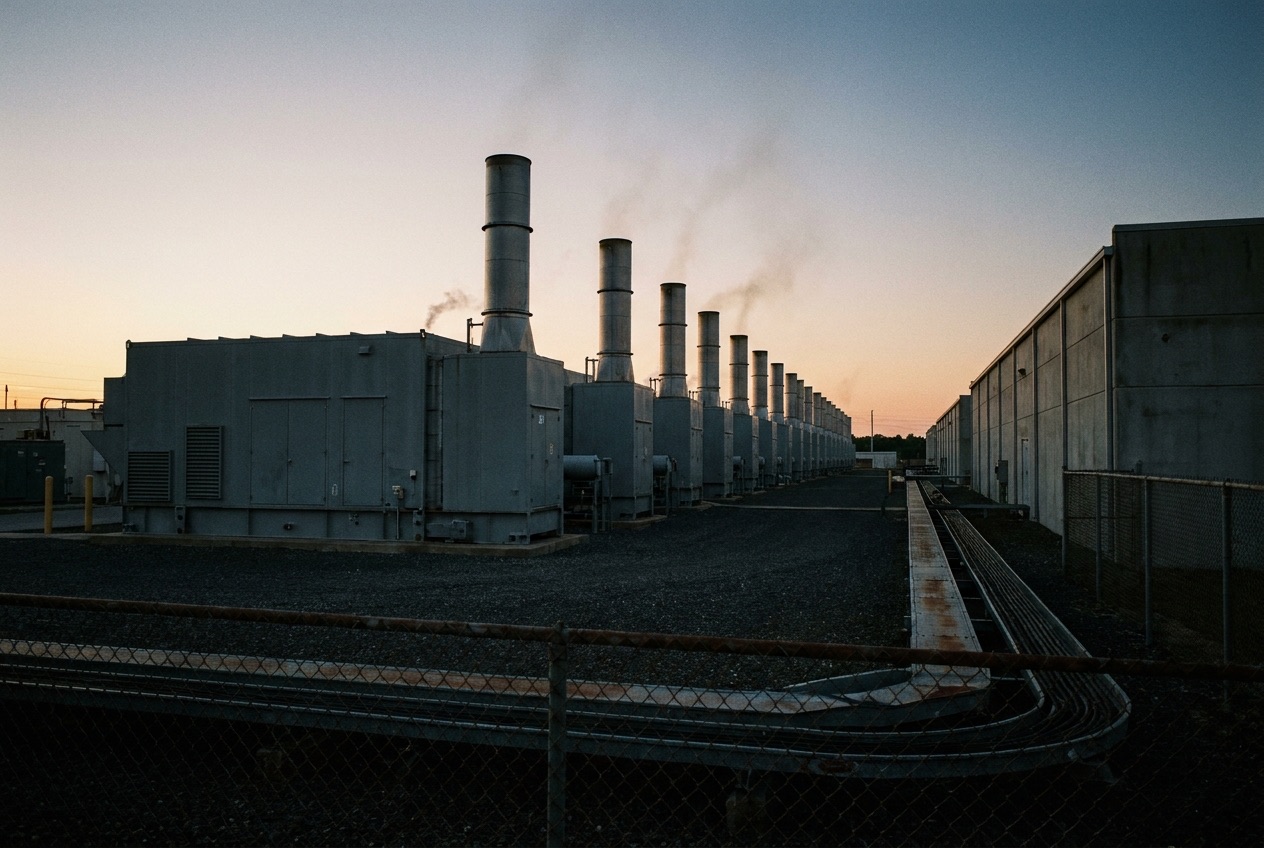
The remarks from the call quoted here are from a transcript published by The Motley Fool. Mr. Johnsen said SpaceX would reach “nearly 2.2 gigawatts” by the end of October and 2.5 to 3 gigawatts by the end of this quarter, as capacity comes online at Memphis and at Southaven, Miss. “Because of the additional capacity coming online this quarter,” he said, “we expect fourth quarter capital expenditures to now be in the range of $35 billion to $40 billion.” With the $48.1 billion spent in the first nine months, that would put the year at $83 billion to $88 billion.
Capital Spending
This Quarter, About Twice the Spending
SpaceX’s capital spending, in billions of dollars, by quarter: its Super Intelligence (AI) segment and the rest of the company.
* Derived. Purchases of property, plant and equipment, as SpaceX reports capital spending, with every period recast to include xAI. The fourth quarter of 2025 is the full year, from SpaceX’s prospectus, less the first nine months, from its third-quarter release. The fourth quarter of 2026 is the range SpaceX’s finance chief gave on its Oct. 20 earnings call.
Mr. Musk said he was “fairly confident” of adding 10 gigawatts more in 2027; next year’s computing, he said, would be “primarily” Nvidia’s Vera Rubin.NVDANasdaq204.64▼9.02−4.2%Nvidia · Friday’s session SpaceX is casting turbine blades and vanes itself, because suppliers “tell us that the blades and vanes are 12 to 18 months behind the rest of the turbine,” he said.
Mr. Johnsen said pricing was “tracking slightly above the high end of the $30 to $50 per watt range” discussed last quarter, and added: “At current pricing, new compute deployments are generating a payback of less than a year.”
At current pricing, new compute deployments are generating a payback of less than a year.
Mr. Musk said SpaceX rents at “effectively the spot market rate” on short contracts, rather than signing long ones. So far, he said, those contracts are renewing “at higher dollars per watt, not lower dollars per watt.” Mr. Johnsen forecast revenue of $33 billion to $37 billion for the first quarter of 2027, more than twice the third quarter’s, against the $22.2 billion analysts expected, according to LSEG data cited by CNBC.The BacklogSpaceX’s backlog was $63 billion at Sept. 30, of which $17.5 billion was deferred revenue. About $42 billion of it is expected to be recognized within a year, Mr. Johnsen said.
In the first nine months SpaceX spent $48.1 billion on property and equipment, against $13.1 billion of cash from its operations. Its debt and finance leases rose to $38.8 billion at Sept. 30 from $22.9 billion at the end of 2025, while it held $51.3 billion of cash and $38.6 billion of marketable securities.The BondsOn June 26 SpaceX closed a $25 billion sale of investment-grade notes, its first, in five tranches maturing from 2031 to 2056, at a weighted average interest rate of 5.855 percent. Asked about funding, Mr. Johnsen pointed to cash flow and the company’s investment-grade rating, and said “there are a number of available pools of debt capital that we are talking to at the moment.” He named no amount. He also said fourth-quarter gross margins would look more like the second quarter’s, citing “some onetime benefits and customer mix” in the third.
The Market
SpaceX’s shares closed on Tuesday at $147.79, down 0.11 percent, before the report. They rose about 8 percent in extended trading that evening, CNBC reported, and were up 10.4 percent in premarket trading early Wednesday.
Supermicro, which builds AI servers, said on Tuesday that it estimates revenue for its quarter through September at $18.5 billion to $19.5 billion, against its own guidance of $14.5 billion to $15.5 billion, “primarily due to increased demand for AI platforms.” The figures are preliminary and unaudited; it reports in full on Nov. 3. On Wall Street on Tuesday, before both reports, the Philadelphia Semiconductor Index slipped 0.29 percent to 11,283.81.
In Seoul on Wednesday the Kospi rose 3.29 percent to 5,735.66, a day after falling nearly 4 percent, as Samsung Electronics gained 5.67 percent and SK hynix 5.81 percent. Foreigners bought a net 659.96 billion won of shares, Yonhap reported, crediting Supermicro’s results with easing worries over AI spending. In Taipei the Taiex rose 1.28 percent to 46,887.77, and Taiwan Semiconductor Manufacturing gained 0.62 percent.TSMNYSE406.13▼25.68−5.9%Taiwan Semiconductor · Friday’s session “In addition to Supermicro, SpaceX reported strong results overnight, boosting more buying in Taipei,” Tsai Ming-han, an analyst at Cathay Futures Consultant, said, as quoted by Taiwan’s Central News Agency.
Tesla and Meta report after the close on Wednesday; for SpaceX, what comes next is its quarterly filing, not yet made, and any new borrowing.
Sources
- Space Exploration Technologies Corp. (SEC Form 8-K, Exhibit 99.1), “SpaceX Reports Third Quarter 2026 Results,” Oct. 20, 2026.
- Space Exploration Technologies Corp. (SEC Form 8-K), “Current Report on Form 8-K, Item 2.02: Results of Operations and Financial Condition,” Oct. 20, 2026.
- Space Exploration Technologies Corp. (SEC Form 8-K, Exhibit 99.1), “SpaceX Reports Second Quarter 2026 Results,” Aug. 4, 2026.
- Space Exploration Technologies Corp. (SEC Form 424(b)(4)), “Prospectus: 555,555,555 Shares of Class A Common Stock (dated June 11, 2026; filed June 12),” June 12, 2026.
- Super Micro Computer, Inc. (SEC Form 8-K, Exhibit 99.1), “Supermicro Provides First Quarter of Fiscal Year 2027 Preliminary Business Update,” Oct. 20, 2026.
- The Motley Fool, “SpaceX (SPCX) Q3 2026 Earnings Call Transcript,” Oct. 20, 2026.
- MarketBeat, via Yahoo Finance, “What SpaceX (SPCX) Said on Its Q3 Earnings Call,” Oct. 20, 2026.
- Reuters, via NBC News, “SpaceX quarterly revenue jumps, mostly from renting out data center capacity,” Oct. 20, 2026.
- CNBC, “Musk says Tesla and SpaceX formed special committees to discuss merger: Live updates,” Oct. 20, 2026.
- CNBC, “SpaceX up 10% in premarket after earnings beat and Musk hints at Tesla tie-up,” Oct. 21, 2026.
- Pepperstone, “SpaceX Q3 Earnings Preview: AI Growth, Capex and Stock Risks,” Oct. 19, 2026.
- Yonhap News Agency, “(2nd LD) Seoul stocks rebound over 3 pct on eased AI spending woes,” Oct. 21, 2026.
- Focus Taiwan (Central News Agency), “Taiex rebounds led by AI stocks as Supermicro raises sales outlook,” Oct. 21, 2026.
- Meta Platforms (PR Newswire), “Meta to Announce Third Quarter 2026 Results,” Oct. 12, 2026.
- Nasdaq, “SpaceX (SPCX), daily historical closes,” Oct. 20, 2026.
- Nasdaq, “PHLX Semiconductor Index (SOX), daily historical closes,” Oct. 20, 2026.