Robotaxis
Tesla Trims Its Spending Plan and Lines Up Credit
Tesla now expects about $20 billion of capital spending this year, down from more than $25 billion, has arranged $30 billion of credit and plans more Cybercab cities.
The company reported on Wednesday that its third-quarter net income fell 43 percent from a year earlier, to $787 million, as its spending on research rose by more than two-thirds. On the call with investors that followed, executives said the Cybercab, the two-seat robotaxi that has carried riders in Austin since Sept. 3, would go to other cities before the end of the year.
Vaibhav Taneja, the chief financial officer, said capital spending “for the next few years would continue to expand” as Tesla adds robotaxis, expands Optimus production, buys computing and builds a semiconductor fab. Call remarks are from a Motley Fool transcript.
Tesla spent $13.01 billion in the first nine months, $4.73 billion of it in the third quarter, more than double a year earlier. The new forecast leaves about $7 billion for the fourth quarter, by Daily Cortex’s arithmetic.
The Credit
The credit, signed on Sept. 29, is a $20 billion three-year term loan that Tesla can draw in stages and revolving lines of $8 billion and $2 billion, with Citibank and Wells Fargo as agents, a filing shows.The Term LoanUndrawn term-loan commitments shrink to $10 billion after a year and to $5 billion after 15 months, and lapse after 18; loans mature in September 2029. The agreements replaced a $5 billion credit line with no borrowings outstanding when it was terminated. “Our confidence in the cash generation capacity of our business and the investments we are making drove our belief to secure shorter-term financing,” Mr. Taneja said.
Revenue was $28.05 billion, 0.2 percent less than a year earlier and above the $27.9 billion analysts expected, according to LSEG data cited by CNBC. Adjusted earnings were 48 cents a share, above the 43 cents analysts expected; under standard accounting they were 22 cents, down from 39 cents a year earlier. The operating margin narrowed to 2.6 percent from 5.8 percent, and free cash flow fell to $1.53 billion from $3.99 billion. Deliveries fell 2 percent, to 486,532, while storage deployments rose to 13.7 gigawatt-hours from 12.5.
One large planned investment is Terafab, Tesla’s chip-making project, which has a research fab under construction in Austin. “It’s certainly in the tens of billions for Terafab,” Elon Musk, the chief executive, said when asked how much capital the chip plant would need, adding that Tesla and SpaceX still had to work out “who pays for what.” In the long run, he said, it would “probably be north of $100 billion.”
It’s certainly in the tens of billions for Terafab.
On a merger with SpaceX, which special committees of both boards are discussing, Mr. Musk added nothing: “I think I said everything that should be said yesterday, tap-dancing through a minefield there.”
The Cybercab
Neither the update nor the call gave the robotaxi fleet’s size. The update says the service had driven “nearly two million cumulative unsupervised miles” by the end of September, eight times as many as three months earlier, and Mr. Musk said the Austin Cybercab fleet had “grown by a factor of 10 since launch.” The Texas line can make more than 125,000 Cybercabs a year, by Tesla’s count.
Asked how the Cybercab fleet would grow beyond Austin, Ashok Elluswamy, Tesla’s vice president of Autopilot, said that “next month, we’ll be launching in Dallas.” Lars Moravy, another executive, said Tesla was “trying to get Cybercabs to customers by the end of this year,” though Mr. Musk said “the vast majority” would be Tesla-owned.
Owners will wait longer. Mr. Elluswamy said that “somewhere around Q2 next year” Tesla could “turn on some of the first customer vehicles to be part of the Robotaxi fleet,” inside Tesla’s geofences. In July 2025, as Electrek recalled, Mr. Musk had said unsupervised FSD would be available “for unsupervised personal use by the end of this year in certain geographies.”
FSD (Supervised), which Tesla says requires active driver supervision, went with more than 75 percent of new cars delivered in North America, up nearly 20 percentage points from the second quarter, and active subscriptions reached 1.74 million, against 1.04 million a year earlier.The Fine PrintMr. Taneja said the North American figure counts sign-ups for a paid subscription at delivery, and that every car Tesla delivers there comes with a free month. The 1.74 million counts upfront purchases and monthly subscriptions and excludes free trials, Tesla says. It is now available in nine European Union countries.
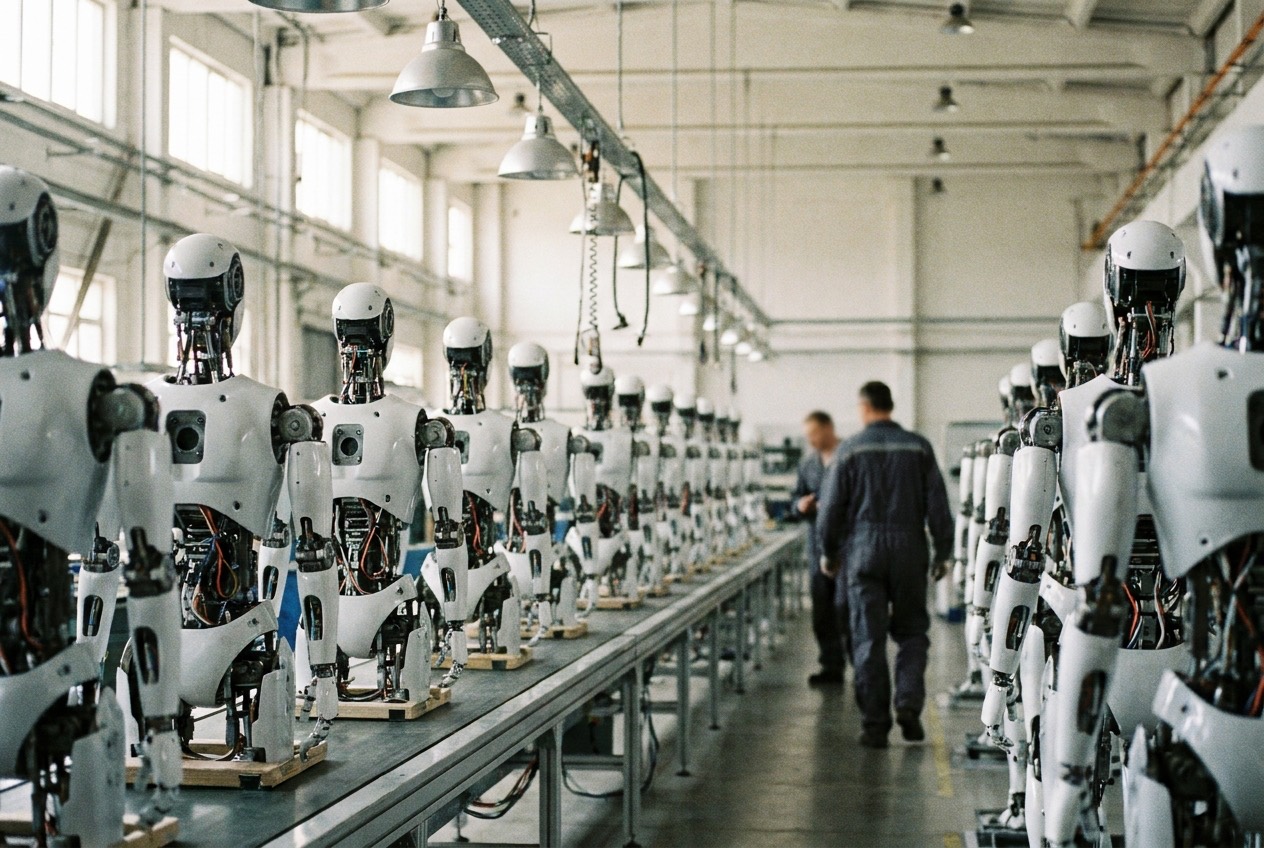
Optimus production began on Tesla’s high-volume lines in Fremont, Calif. “The bots coming off this line are the first production-quality bots that we have manufactured,” the update said. Reaching 20,000 robots a week would take “probably at least a year, maybe a little longer,” Mr. Musk said.
The Cybercab has had its first crash. Tesla told the National Highway Traffic Safety Administration that one was damaged when it drove at about 5 mph into a large, water-filled pothole, with a safety monitor aboard and no passengers, the Austin American-Statesman reported on Wednesday. Mr. Elluswamy said Tesla widens service hours only as its software allows: “we just want to make sure that there’s not a single safety incident.”
The agency is also examining how Tesla certified the Cybercab, which lacks permanently attached controls such as a steering wheel and pedals; it opened the inquiry on Sept. 3, the day rides began.The AuditNHTSA issued a special order on Sept. 10 and says it will consider the extent to which Tesla’s certification depended on determinations that certain federal standards do not apply to the Cybercab. Tesla asked for eight more weeks, citing “the voluminous nature of the request”; it got 30 days. Tesla’s answer to the federal regulator’s special order on how it certified the Cybercab is due on Oct. 30.
Tesla’s shares closed on Wednesday at $386.47, up 3.41 percent, before the report, then slid more than 3 percent in extended trading, CNBC reported. Next come Tesla’s quarterly report, which will carry the credit agreements in full, Dallas and, on Dec. 3, the annual meeting.
Sources
- Tesla, Inc. (SEC Form 8-K, Exhibit 99.1), “Q3 2026 Update,” Oct. 21, 2026.
- Tesla, Inc. (SEC Form 8-K), “Current Report on Form 8-K, Item 2.02: Results of Operations and Financial Condition,” Oct. 21, 2026.
- Tesla, Inc. (SEC Form 8-K), “Current Report on Form 8-K, Item 1.01: the term loan and revolving credit agreements,” Sept. 29, 2026.
- Tesla, Inc. (SEC Form 10-Q), “Quarterly Report for the quarter ended June 30, 2026,” July 23, 2026.
- The Motley Fool, via The Globe and Mail, “Tesla (TSLA) Q3 2026 Earnings Call Transcript,” Oct. 21, 2026.
- CNBC, “Tesla beats on earnings and sales even as auto revenue declines,” Oct. 21, 2026.
- Austin American-Statesman, via Yahoo News, “Tesla reports first Cybercab crash as Austin robotaxi wreck totals increase,” Oct. 21, 2026.
- National Highway Traffic Safety Administration, “Audit Query AQ26002, opening resume: Tesla Cybercab FMVSS Certification,” Sept. 3, 2026.
- National Highway Traffic Safety Administration, “AQ26002: Special Order Response Extension (memorandum to file),” Sept. 29, 2026.
- Electrek, “Tesla pushes unsupervised FSD to Q2 2027, only in Robotaxi zones,” Oct. 21, 2026.
- Nasdaq, “Tesla, Inc. (TSLA) historical quotes,” Oct. 21, 2026.
- Tesla, Inc. (SEC Schedule 14A), “Definitive Proxy Statement for the 2026 Annual Meeting of Shareholders,” Oct. 19, 2026.