The Offering
Aleph Goes Public; Shares Rise 21% in Record Debut
Superintelligence Lab Raises $62 Billion, More Than Double Aramco’s Record, and Ends Day Worth $1.7 Trillion
PROSPECTUS WARNED OF LOSS OF CONTROL
First Trade Comes at 11:52 After Two-Hour Delay; Founder Tells Floor ‘The Hard Part Is Ahead of Us’
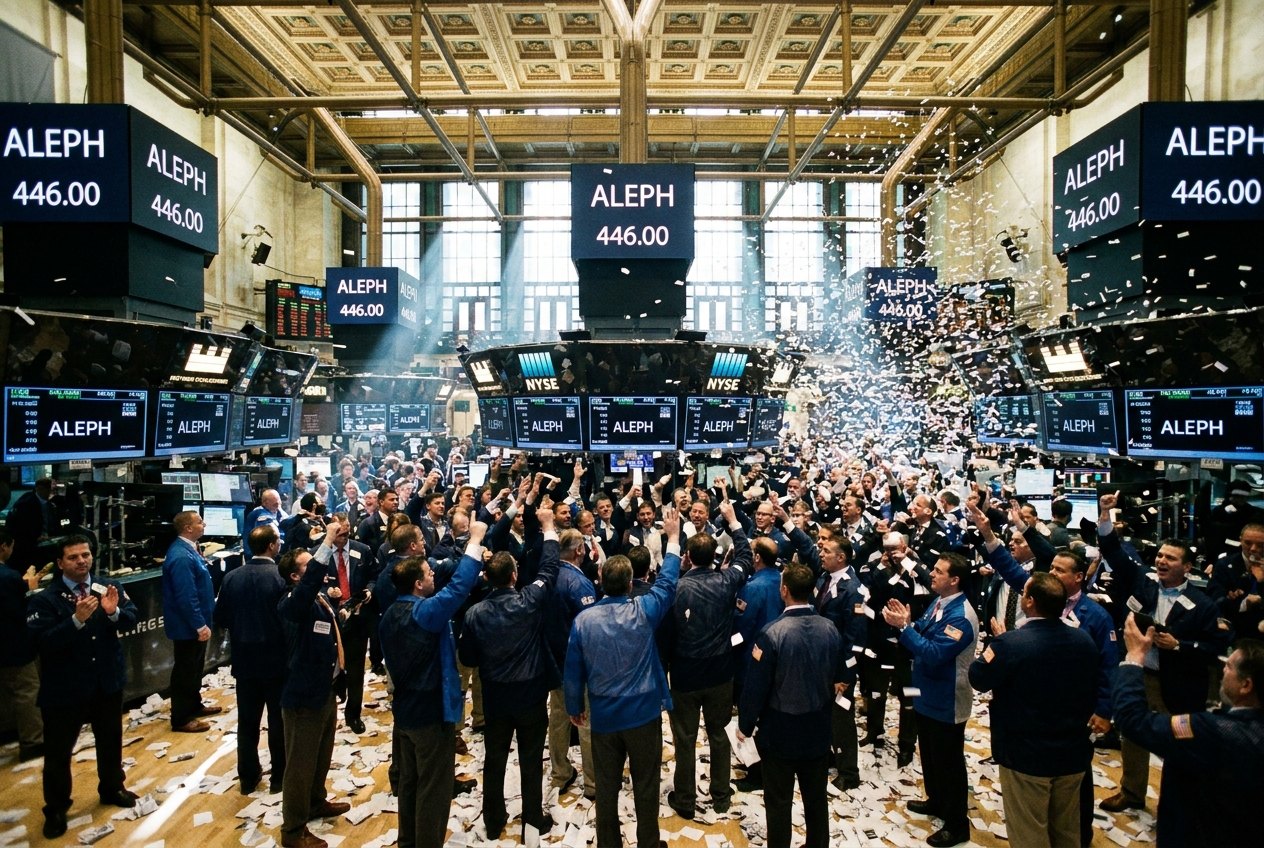
NEW YORK, Oct. 12 — Imogen Achterberg rang the opening bell of the New York Stock Exchange at 9:30 a.m. Monday, leaned toward the microphone on the balcony and told the floor, “The hard part is ahead of us.” Then, like everyone below her, she waited.
Her company, Aleph Superintelligence, had sold $61.9 billion of stock the night before, the largest initial public offering in history and more than double the previous record. Its shares would not change hands for another two hours and 22 minutes.
When they did, at 11:52 a.m., the price was $446.00, 31 percent above the $340 at which they had been sold. By the close the shares stood at $412⅝, up 21.4 percent, and a company founded in 2021 was worth about $1.7 trillion.
Every buyer had been told, in writing, that the company might not be able to control what it is trying to build. The warning appears on Page 37 of Aleph’s 412-page prospectus, among the risk factors that companies are obliged to list and investors are accustomed to skipping.Risk FactorsA required section of a prospectus setting out the ways an investment can go wrong. Lawyers draft it to be complete; few readers finish it. It reads, in full:
“We are attempting to build systems that exceed human capability across most economically valuable work. We may succeed. If we succeed, we may not be able to reliably control those systems, and a decline in the value of your investment may be the least of the consequences.”
On trading desks the passage is known as the Page 37 clause. It slowed no one down. On Sunday night the 41 banks managing the sale priced it above the $290-to-$320 range at which it had been marketed, and still could not fill every order.
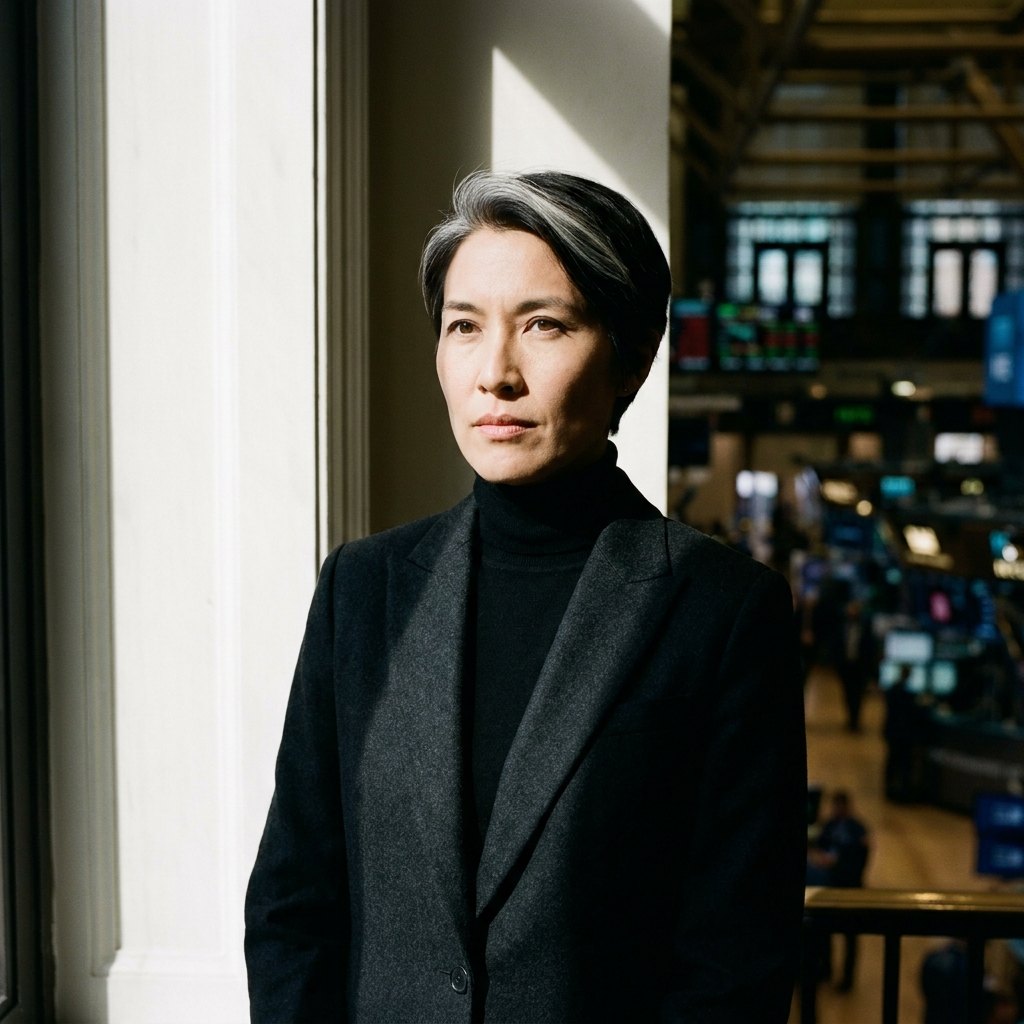
The delay was arithmetic. At 9:30 there were so many orders to buy Aleph and so few to sell that no price would satisfy both, and the designated market maker — the floor firm charged with finding one — held the stock until the two sides met.The IndicationBefore a crowded opening, the market maker publishes an “indication,” the range where it expects trading to begin, and revises it as orders arrive.
The first indication, posted at 10:41 a.m., was $375 to $395. It was raised three times. Brokers in navy jackets stood ten deep around the market maker’s post, telephones at their ears, while Ms. Achterberg spent much of the wait by a tall window at the back of the balcony, arms folded, saying little.
“A deal this size, usually you can’t hear yourself think,” said Vincent Arcuri, who has worked on the floor for 36 years. “For two hours you could hear the air-conditioning.”
At 11:52 the screens above the floor read ALEPH 446.00. A cheer went up, arms went up, and white confetti drifted down over the posts.
The stock touched its high, $451.50, at 12:06 p.m., then spent the afternoon giving back ground, reaching $398.25 at 2:41 p.m. before recovering to close at $412⅝. Some 341 million shares changed hands, nearly twice the 182 million sold in the offering.ALEFNYSE4125⁄8▲725⁄8+21.4%Aleph Superintelligence · since the offering
ALEF · First Session
Thirty-one percent at the open, twenty-one at the bell
Aleph’s share price, minute by minute, Monday.
At the offering price Aleph was valued at about $1.4 trillion; by 4 p.m. the market had added roughly $300 billion to the figure. The previous record for a stock sale belonged to Saudi Aramco, which raised $29.4 billion in December 2019, counting the extra shares sold to meet demand. The difference between the two offerings, about $32.5 billion, would by itself have been a record.
The Record
More than double the old mark
The largest initial public offerings in history, by money raised.
- Aleph Superintelligence2026$61.9
- Saudi Aramco2019$29.4
- Alibaba2014$25.0
- SoftBank Corp.2018$23.5
- Agricultural Bank of China2010$22.1
- I.C.B.C.2006$21.9
Page 37
The prospectus describes a company whose models are used by some 600 million people a week, growing at a pace with few precedents and losing money at a pace with fewer. Aleph lost $17.8 billion in the 12 months through June, mostly on computing power, and has committed $410 billion to compute over the next eight years. Revenue over the same 12 months was $21.3 billion; by September, the company says, it was running at an annual rate of $38 billion.
The commitments come to about $140 million a day. For each dollar of revenue, Aleph lost about 84 cents.
I don’t know what that says about the company, but I know what it says about us.
Monday’s buyers acquired little say in how any of it is spent. Aleph’s Class B shares carry 20 votes apiece, and Ms. Achterberg and Samuel Oduya, a co-founder and the chief scientist, control 61 percent of the vote between them.
Reporters asked her about Page 37 after the open. Ms. Achterberg did not retreat from the warning: “We are not asking you to trust us. We are asking you to watch us.”
“Page 37 is the only page of a prospectus I ever heard anybody read out loud down here,” Mr. Arcuri said. “Then they went back to their phones and bought.”
Agnes Thornbury, who has spent three decades betting against stocks she considers overpriced, called it the most honest paragraph she had read in a securities filing. She is not short Aleph; on a first day there are rarely shares to borrow, and she said she would not have been anyway.
“Risk factors are written so that nobody can say later they weren’t told,” Ms. Thornbury said. “This one was written by someone who wanted to be believed. I think people did believe it. They bought anyway. I don’t know what that says about the company, but I know what it says about us.”
The principal check on the company is a five-member Mission Trust, which can delay for up to 180 days the deployment of any system Aleph’s own evaluations rate “Level 5.”Level 5Aleph’s highest internal rating: performance above that of expert humans across most cognitive work. Its five independent members exercise that power through a single Class T share, known as the golden share.
The trust is led by Harold Ostrander, 71, a retired federal judge. Reached by telephone, Judge Ostrander declined to say whether the trust had yet reviewed anything. “We are not a brake,” he said. “We are a pause. The difference is 180 days wide, and we would use every one of them if we had to.”
Ms. Thornbury was unpersuaded. “It’s a pause button,” she said, “wired to an exam the company writes and marks on its own.”
The Money
Most of the money will go to computing power, much of it at a data center campus in Mercy, Tex., where Aleph is the anchor tenant.Mercy, Tex.Pop. 3,912 (2020 census). Seat of Caprock County, about 70 miles southwest of Lubbock. Founded in 1891 as a railroad stop. The campus, developed by Tessellate Infrastructure, is planned as nine buildings, each about 1,700 feet long. Three are energized, drawing 1.8 gigawatts; at completion, in 2028, the campus is to draw 4.5 gigawatts.
Aleph has also agreed to buy, for 20 years, the entire output of Hollis Bay, a Lake Erie nuclear plant, shut in 2019, that on Monday cleared its final Nuclear Regulatory Commission inspection.Hollis BayOne 860-megawatt reactor near Port Hollis, Ohio, owned by Lakeshore Generation. Fuel loading is set for November; power is to reach the grid in spring 2027. The price was not disclosed. Analysts put it at about $95 a megawatt-hour.
Some of the money arrived in small amounts. Fifteen percent of the shares, about 27 million, were set aside for individuals buying through brokerage apps.
Dolores Amato, 67, a retired court stenographer in Yonkers, asked for 25 shares on Thursday and was given seven on Sunday night. By the close she was $508 ahead, on paper.
She had read Page 37 twice, the second time aloud to her sister over the telephone. Then she printed it out, and it is on her refrigerator now, under a magnet shaped like a lemon.
“I took down what people said for 34 years,” Ms. Amato said. “Most of them didn’t mean half of it. These people mean every word.” Asked why, in that case, she had bought, she said, “Because they mean every word.”
The page is still on the refrigerator, and the shares are on her phone. She said she looks at one of them more often than the other, and would not say which.