Power
Shuttered Ohio Reactor Will Run Again, for One Customer
Hollis Bay, Closed in 2019 When Gas Was Cheap, Clears Its Final Federal Inspection; Aleph Will Buy Every Megawatt-Hour for 20 Years
‘NOBODY SAYS GOODBYE TO A REACTOR’
The Power Stays on the Regional Grid and None of It Goes to Texas; a Ratepayer Group Asks Who Pays for the Wires
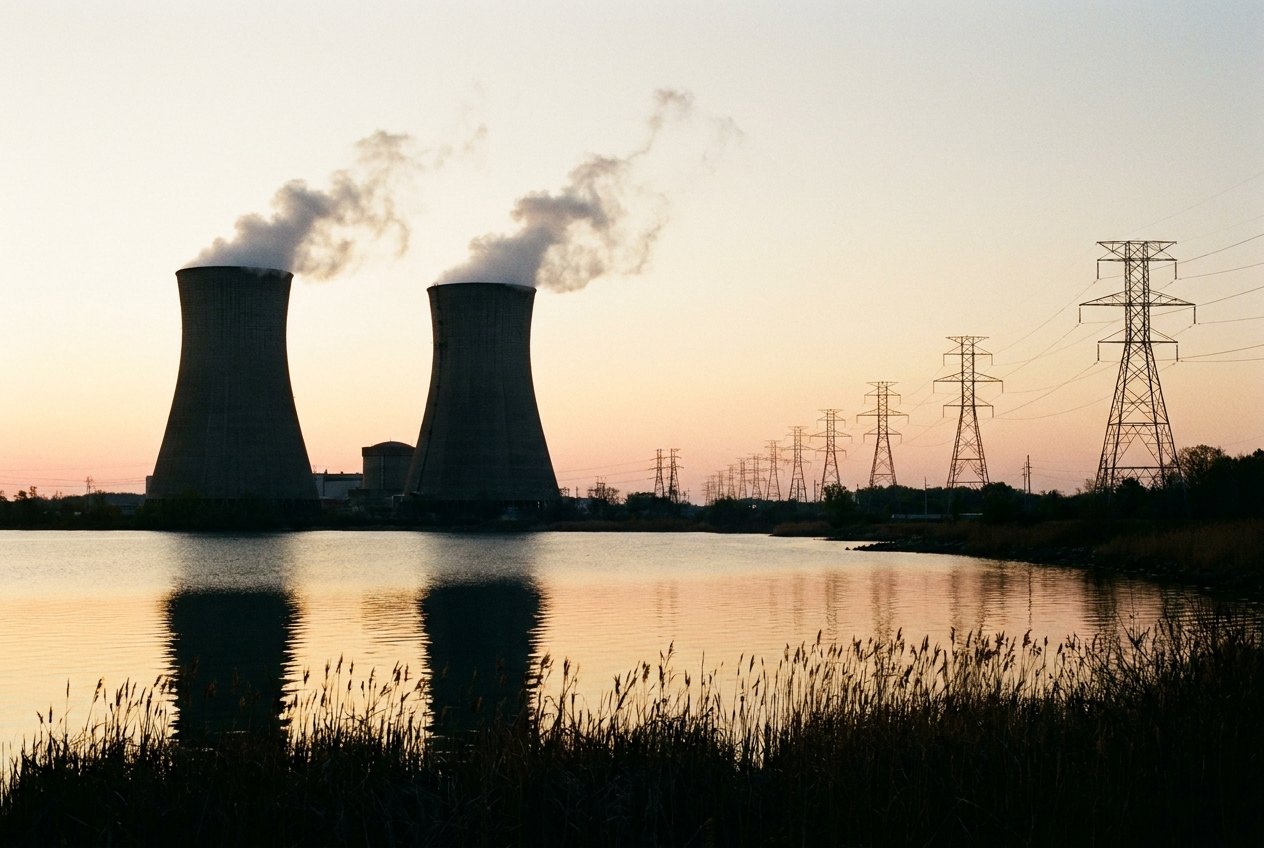
PORT HOLLIS, Ohio, Oct. 12 — Seven years ago the Hollis Bay Nuclear Station shut down its reactor and sent most of its people home. On Monday the plant passed the last test it needed to run again, and when it does, it will work for one company.
Hollis Bay, an 860-megawatt reactor on the southern shore of Lake Erie that closed in 2019, cleared its final Nuclear Regulatory Commission inspection on Monday, and every megawatt-hour it produces for the next 20 years will be bought by Aleph Superintelligence. Aleph’s shares began trading in New York the same day.ALEFNYSE4125⁄8▲725⁄8+21.4%Aleph Superintelligence · since the offering Fuel loading is scheduled for November, and the first power should reach the grid next spring.
The plant’s owner, Lakeshore Generation, closed Hollis Bay because cheap natural gas had made a lone reactor uneconomic. It announced the restart in March 2025, at a cost of $2.3 billion — a sum that made sense only with a buyer willing to pay well for power that runs day and night, in any weather, without burning anything.
Dale Szymanski, 61, the plant manager, has spent 30 years at Hollis Bay, counting the quiet ones. He was in the control room in 2019 when the reactor was taken off line for what everyone then believed was the last time.
“We turned off the lights in 2019 and said goodbye,” Mr. Szymanski said. “Nobody says goodbye to a reactor and means see you later.”
On Monday afternoon he walked the turbine deck past a generator that had spent six years under canvas, and past young operators who were in high school when the plant closed. Some of the old crew have come back. One had become a chemistry teacher in Sandusky and returned, Mr. Szymanski said, “for the overtime and the parking space.”
In Port Hollis, where the towers can be seen from every dock and bait shop, the news was received the way a mill town receives word that the mill is reopening: gladly, and with questions about who gets hired.
What Aleph has bought is easy to misunderstand. The deal is a matter of bookkeeping, not wiring. Hollis Bay’s electricity will not go to Aleph’s campus in Texas; it will flow into PJM, the regional grid that includes Ohio, and Aleph will count it against what its data centers in central Ohio draw from that same grid.PJMPJM Interconnection runs the high-voltage grid and wholesale power market for all or parts of 13 states and the District of Columbia, from New Jersey to Illinois. Most of Texas runs on a grid of its own, ERCOT, with only thin links to the rest of the country.
A grid behaves less like a parcel service than like a lake. A megawatt-hour poured in at Port Hollis cannot be followed to any particular light bulb in Columbus or anywhere else. What Aleph pays for is the plant’s output and the right to claim it — to set each megawatt-hour Hollis Bay delivers against one its Ohio data centers use.
Neither company would disclose the price. Analysts estimate it at about $95 a megawatt-hour, a premium Aleph is willing to pay because a reactor runs around the clock, which is what a data center does and what the wind and the sun cannot promise.The BillAt $95 a megawatt-hour, an 860-megawatt reactor running every hour of the year would earn about $715 million. Refueling outages bring the real figure lower.
Not everyone along the lake regards the arrangement as a gift. Ellen Marsh of the Lake Erie Ratepayers Alliance, a consumer group, said households would still be paying for the wires and backup power that Aleph’s data centers lean on whenever the reactor is not running.
“They bought the power plant,” Ms. Marsh said. “They didn’t buy the grid. When Hollis Bay goes down for refueling, those data centers don’t go dark. They lean on the same wires as my members, and my members pay for the wires.”
Lakeshore Generation said in a statement that the restart would return 860 megawatts to the region on land that already held a power plant, using a grid connection that already existed, and that the price risk rested with Aleph rather than with households.
Late Monday, Mr. Szymanski stood on the riprap below the cooling towers, where the reeds come down to the water. The towers stood dry against a white sky, as they have since 2019. He looked up at them the way a farmer looks at a field in March.