The Build-Out
The Machine Comes to Mercy
A West Texas Town of 3,912 Now Lives Beside Nine Halls That Will Draw 4.5 Gigawatts, and Has Not Finished Deciding What It Thinks
‘MORE THAN MY GRANDFATHER COULD COUNT’
Tax Rolls Rise From $410 Million to $11.6 Billion; a Stadium Goes Up, the Wells Go Down and the Milky Way Goes Out
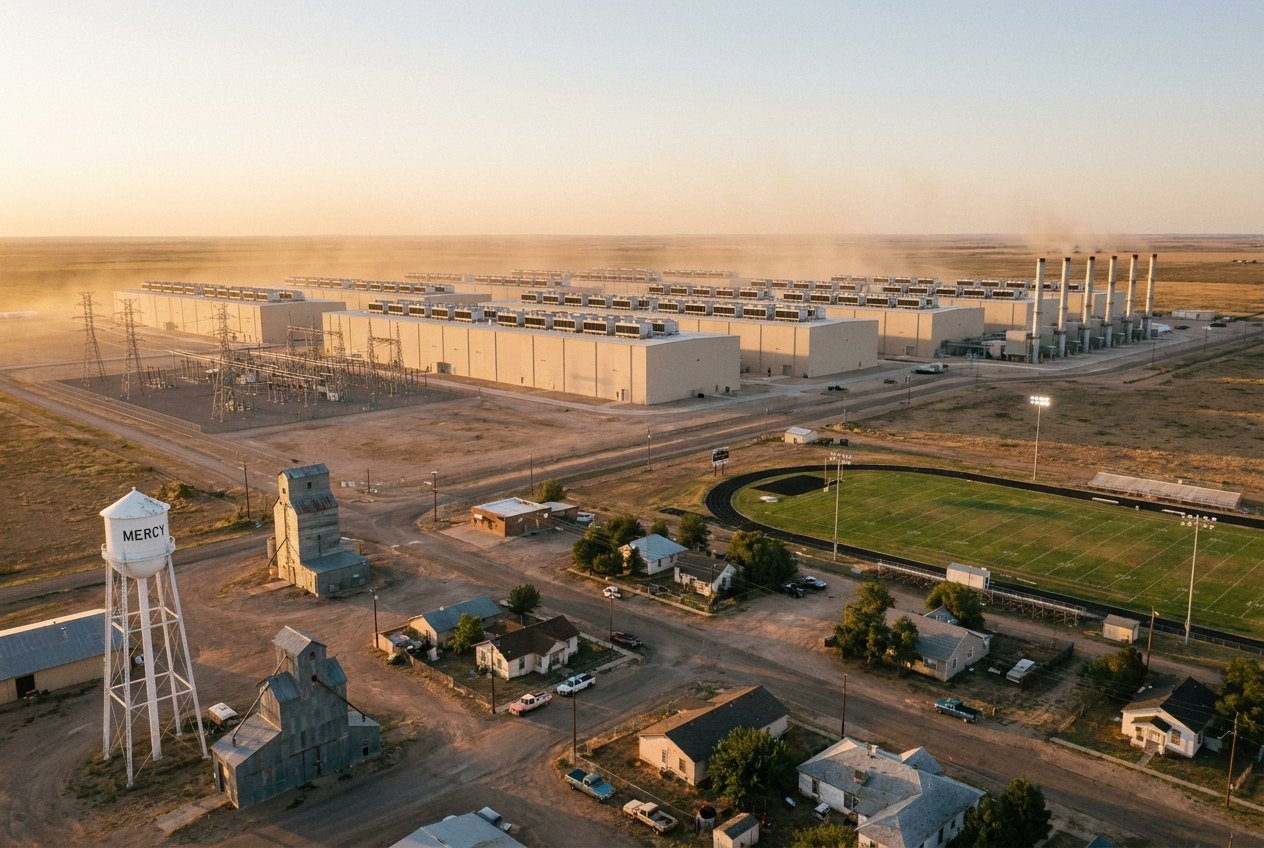
MERCY, Tex., Oct. 11 — The tacos start at 3:30 a.m. By 4, Annette Liu has both griddles going, a line out the door of the Mercy Café and a hum in the front window that she stopped hearing sometime last spring.
The line is pipefitters and electricians in flame-resistant shirts, crane operators, a surveyor up from Midland and two brothers from Louisiana who sleep in a camper behind the feed store. Ms. Liu, 47, used to lock the door at 2 p.m. The café is now open 24 hours, and she sells about 900 breakfast tacos a morning, wrapped in foil, six to a sack.
“I used to know everybody who came in,” she said. “Now I know everybody’s order.”
Mercy, a cotton-and-cattle town of 3,912 in West Texas, now lives beside one of the largest computing installations ever built: nine halls that will draw 4.5 gigawatts when they are finished in 2028.GazetteerMercy, Tex. Seat of Caprock County, on the Llano Estacado about 70 miles southwest of Lubbock. Elevation 3,100 feet; pop. 3,912 (2020 census). Founded 1891 as a railroad stop. Cotton, cattle and, lately, computation. The anchor tenant is Aleph Superintelligence, which raised $62 billion on Sunday night in the largest initial public offering in history. Much of the money is meant for computing, and a good deal of the computing is meant for here.
The campus is being built by Tessellate Infrastructure, a private developer, on pasture that until 2024 held cattle, mesquite and a windmill or two. Three halls are energized. A fourth comes on this winter. The other five are steel and concrete in various stages of becoming.
The campus has brought Mercy more money than anyone ever imagined, a glow nobody asked for, a hum nobody can turn off and a question about water that nobody can yet answer. Most people here hold several of those thoughts at once. Some hold all of them before breakfast.
Each hall is about 1,700 feet long, longer than the Empire State Building is tall. From the highway they do not look like buildings so much as like a pale weather front that decided to stay.
The three running now account for 1.8 gigawatts. Power arrives from three directions: 2.1 gigawatts of gas turbines owned by Gridline Energy, their exhaust stacks lined up along the fence like organ pipes; a new 345-kilovolt line from the ERCOT grid; and a 600-megawatt field of solar panels and batteries.A GigawattA billion watts, roughly the output of one large nuclear reactor. The Hollis Bay reactor in Ohio, whose restart is reported on this page, is rated at 860 megawatts.
Finished, the campus will need more than twice the generating capacity of Hoover Dam. The town of Mercy appears in the chart below, too. It takes a moment to find.
Isotype
Nine halls, two Hoover Dams
Each pylon stands for 500 megawatts of power.
- Mercy Campus, finished20284.5 GW
- Mercy Campus, todaythree halls1.8 GW
- Hoover Damnameplate2.08 GW
- Hollis Bay reactorOhio860 MW
- The town of Mercyevery home← hereabout 2 MW
The Hum
The hum came with the first hall. It is not loud, exactly. It is a low, level note, part transformer and part fan, that lies beneath every other sound in Caprock County and makes itself known when the others stop: when the wind drops, when the last truck has passed on the farm-to-market road, at 2 a.m., when a person cannot sleep and has begun to wonder why.
The county passed a noise ordinance in May. Tessellate says the campus is within the limit. Several families along the fence line say the limit is the problem.
Delfina Ruiz, 71, whose family had been on the land since 1911, sold 2,400 acres of it to the developer in 2024 and will not say for how much. “More than my grandfather could count,” she said. She kept the house, the pens and the family plot with its iron fence, and from her porch she can see the halls standing where the cattle used to water.
She is not bitter, and she does not pretend to be glad. “Granddad sold calves for whatever Fort Worth said they were worth,” she said. “I got to name my price. That’s not nothing.” She listened for a moment. “It sounds like the whole county left the refrigerator open.”
It sounds like the whole county left the refrigerator open.
Inside the halls the hum becomes a steady rush, like standing behind a waterfall.
The aisles run straight to a vanishing point between black racks, under white pipes as thick as a man’s thigh that carry coolant in a closed loop to chips that would otherwise cook. There are no windows. A technician in a white hard hat can walk for several minutes without reaching the far wall.
“People ask what goes on in here,” said Bram Kowalczyk, Tessellate’s site director. “Arithmetic. An enormous amount of arithmetic, very fast, all night.” The machines in these halls train and run Aleph’s models, which about 600 million people use each week. Very few of them have heard of Mercy.
It is a building with the proportions of a cathedral and the population of a lighthouse.

The Money
Caprock County’s taxable property, worth $410 million before the campus, is now worth $11.6 billion, and the money has paid for a $68 million stadium and a 30 percent raise for teachers. Tessellate’s tax bill would be larger still but for a 10-year partial abatement the county granted to win the project, and the abatement has divided the town ever since.The AbatementA promise by a local government to forgo part of a new project’s property tax for a set period. Critics say Caprock County gave away too much; supporters say a partial bill on billions is still a large bill in Caprock County.
The stadium seats more people than live in Mercy. Dub Hendricks, 52, the head football coach of the Mercy Mustangs, still walks out to midfield some afternoons just to look at it.
“I coached eleven years in a field house with a leak over the whirlpool,” he said. “Now I’ve got a press box with an elevator. I don’t ask where it came from. I know where it came from.”
Then there are the workers. The construction force has run as high as 7,800, twice the population of the town, most of them living in RV parks along the highway that everyone calls the man camps.Man CampsTemporary RV parks and modular bunkhouses for construction crews, a fixture of West Texas oil booms long before anyone built a data center here. When the halls are finished, about 1,100 permanent jobs are expected to remain.
The mayor, Royce Teague, is for the campus and says so first, before he says “but.” Mr. Teague, 58, owns Teague Hardware on the courthouse square, where work gloves now arrive by the pallet.
“Put down that I’m for it,” he said. “Then put down the but. The but is water. The but is what this place looks like in twenty years, when the machines in there are old and somebody in an office a long way from here decides whether to keep the lights on.”
The Water
The campus draws about 1.1 million gallons of water a day from the Ogallala Aquifer, and the town’s wells have dropped. The OgallalaAn underground reservoir beneath parts of eight states, from South Dakota to Texas. Under the southern High Plains it recharges slowly, and in many places it has been falling for decades.The water in the halls circles in a closed loop, Mr. Kowalczyk said; it is the gas turbines, and an evaporative assist on the hottest summer afternoons, that drink. “We count every gallon,” he said. “I understand people would like to count them, too.”
Kendra Osei, a hydrogeologist at Texas Tech University in Lubbock, warns against tidy arithmetic in either direction. The aquifer beneath the South Plains was falling long before anyone in Mercy had heard of Aleph, drawn down by most of a century of irrigation, she said, and 1.1 million gallons a day is about what a few center-pivot sprinklers pump on a summer day.
“The difference is that a cotton farmer shuts his pivots off in September,” Ms. Osei said. “This doesn’t have a September.”
At the café at 4 a.m., the talk is overtime and Friday’s game. At the hardware store by noon, it is the wells.
On Friday night the Mustangs played at home. The stadium lights came up at dusk, and for a while the two kinds of light seemed evenly matched. By the second quarter it was no contest.
“For the first time in my life,” Mr. Hendricks said afterward, “the stadium lights aren’t the brightest thing in town.”
The glow of the campus can be seen 40 miles away, and the Milky Way, which hung over Mercy for as long as there has been a Mercy, is gone. Older people mention it the way they mention a store that closed.
When the game ended, the crew shut off the stadium lights one bank at a time, and the crowd walked out to the parking lot by the other light.
Ms. Ruiz watched from her porch. She does not go to the games anymore, but she can always tell when one is over, because one light goes out and the other does not. If she tips her head all the way back and waits, a few stars still come through — the bright ones, the ones with names.