The Low Sky
Drones Take to Dallas Sky, Kept Apart by Software
Under New Federal Rule, 1,412 Pilotless Flights Cross Dallas–Fort Worth in 16 Hours Without an Injury
HAWK DOWNS ONE; PARACHUTE OPENS
Retired Controller Keeps Watch From a Lawn Chair as Software Does the Work He Did for 31 Years
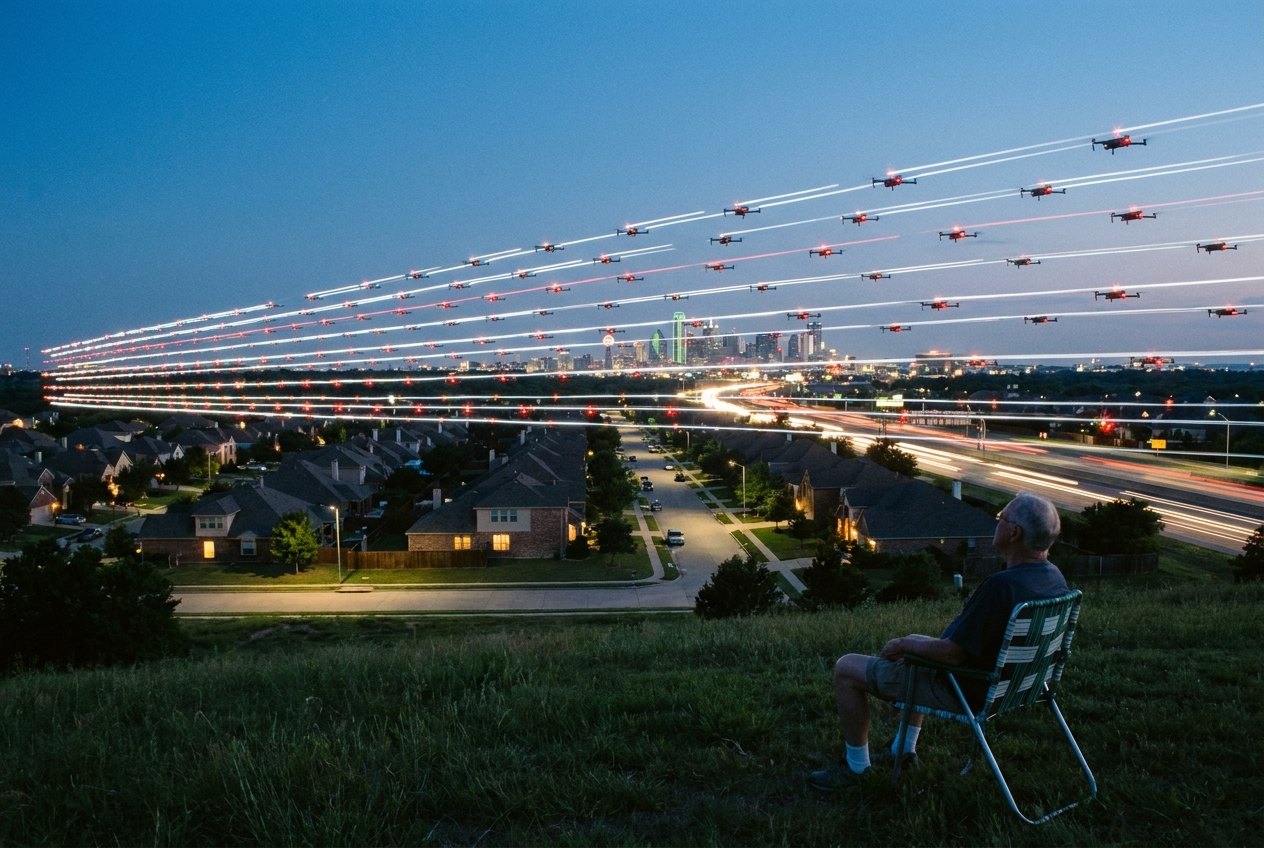
MANSFIELD, Tex., Oct. 12 — Earl Whitcomb brought a folding lawn chair, a thermos of coffee and a pair of binoculars he never needed. A little before midnight on Sunday he set the chair on a hill at the south end of town, faced north toward Fort Worth and Dallas, and waited for the sky to get a schedule.
For 31 years Mr. Whitcomb kept airliners apart from a darkened room at the DFW approach control. Shortly after 12:01 a.m. Monday, the first small lights appeared over the subdivision below him and moved off in single file, each at its assigned height, none of them talking to anyone.
“For thirty-one years I kept airplanes apart,” said Mr. Whitcomb, who is 74. “Now nobody keeps these apart — the software does. I came out to see if it’s any good.”
Under Part 108, a federal rule that took effect at 12:01 a.m. Monday, drones may fly routinely beyond their operators’ sight. Part 108Until Monday, a commercial drone generally had to stay within sight of its pilot unless the operator held a special waiver. Part 108 makes flight beyond visual line of sight — BVLOS, in the trade — routine for aircraft up to 55 pounds, below 400 feet, in managed corridors. Over Dallas–Fort Worth, they made 1,412 flights in the first 16 hours, through 4 p.m., without an injury.They fly in the Trinity Corridor Network, 31 lanes in which the traffic is kept apart not by controllers but by software. The first day’s cargo was the things a city runs short of or forgets: prescriptions, groceries, blood for hospital trauma units and one wedding ring, left at home by an owner who has asked not to be identified.
The Lanes
The lanes are easier to grasp from a lawn chair than from a rulebook. Most follow routes the region stopped noticing long ago — the forks of the Trinity River, the freeways, the rail lines, the power-line easements — at heights between 200 and 350 feet: above the treetops, below the 400-foot ceiling the rule allows, and far beneath the airliners Mr. Whitcomb used to line up for the runways.
Where two lanes cross, they cross at different heights, the way an interchange stacks one road over another. Drones headed in opposite directions are assigned different altitudes as well.
“Same idea as ours,” Mr. Whitcomb said. “Pick a direction, get an altitude.”
The Low Sky
The Trinity Corridor Network
Thirty-one lanes between 200 and 350 feet, kept apart by software.
What keeps two drones from meeting inside a lane is a system called UAS traffic management, or UTM.UTMUAS stands for unmanned aircraft system, the government’s term for a drone and its controls. UTM is the software that holds every flight’s reservation and refuses any that would overlap another. It works less like air traffic control than like a restaurant’s reservation book. Before takeoff, each drone must book a slice of sky — a lane, a height, a window of minutes — and no two bookings may overlap. If the slice is taken, the later flight waits on the ground or is offered another height. The operators’ systems share their bookings with one another, so no two companies can be promised the same air.
Once aloft, a drone broadcasts its identity and position about once a second, and the system checks that it stays inside its booking.Remote IDA digital license plate. Each drone must broadcast its identity, position, altitude and speed, readable by the police and, with the right app, by anyone nearby. A drone slowed by a head wind has its booking stretched, and the flights behind it are nudged back. Anything that never booked — a news helicopter, a kite, a bird — is left to the drone’s own sensors to avoid. If all of that fails, the rule requires a parachute.
Mr. Whitcomb’s old system ran on voices. “Three miles or a thousand feet,” he said, reciting the separation standard he worked to near the airports, “and you said it out loud.” Every instruction he gave went out over a radio and came back in a pilot’s voice. These instructions pass between computers in a building he has never seen.
“It looks fine on a quiet night,” he said. “I’d like to see it on a Friday in May with a line of thunderstorms coming through.”
The night was quiet. Between midnight and first light he counted 17 drones on the nearest lane, which runs along the highway toward Fort Worth. Each held its height exactly; none wandered. The sky over a city has always held the scheduled and the accidental — the airliners on their approaches, the stars on theirs, and in between whatever happened to be flying. On Monday, the in-between acquired a timetable.
Now nobody keeps these apart — the software does. I came out to see if it’s any good.
At 2:14 a.m., a drone delivered O-negative blood to a hospital trauma unit in Fort Worth. It set down on a painted square atop the county hospital’s parking garage, where Shayla Brooks, a trauma nurse, waited in scrubs and a fleece. O-negative is the blood given when there is no time to learn a patient’s type. Until this week, the same errand went by van.
“Honestly? I didn’t look up,” Ms. Brooks said. “I looked at the label.” She checked the units against the order and carried the cooler to the elevator. Before the doors closed, the drone was gone.
Forty to One
At Wren Aerial, the region’s largest operator, one person supervises up to 40 drones at once. That is the most the rule allows. The company has 1,100 drones in Dallas–Fort Worth and runs them from a former printing plant in the Design District, where at 9 on Monday morning the loudest thing in the room was the air-conditioning. Each operator sat before a map of the lanes scattered with small green chevrons, and for long stretches nobody touched anything.
“If somebody in here is busy, something has gone wrong,” said Tomás Ibarra, Wren’s chief executive, who had spent the night in the room and looked it. Bankers expect his company to file for a stock offering before spring; Mr. Ibarra declined to discuss that and went back to the screens.
Then, late in the morning, one of the chevrons turned red.
The day’s one mishap came over Grand Prairie, where a red-tailed hawk struck a drone and sent it down by parachute into a church parking lot. The operator responsible for it, who had three dozen others on her screen, did not bring it down. Nobody did. Its flight computer had sensed the tumble, cut the motors and fired the parachute, and the traffic system had cleared its slice of sky — all in the second or two before the chevron changed color.
Her work came afterward: a call to the Grand Prairie police, a van to fetch the drone, another aircraft for the prescription it had carried. On a Monday, the lot was nearly empty. The hawk left the scene.
The first noise complaint had come in before breakfast. Gene Pruitt, Mr. Whitcomb’s neighbor in Mansfield, filed it with the city, which has no authority over the air.
“It’s like a mosquito with a mortgage,” Mr. Pruitt said.
The Federal Aviation Administration puts the sound of a drone overhead at about 55 decibels — “about a quiet conversation,” in the agency’s words.55 DecibelsLoudness climbs on a logarithmic scale; each added 10 decibels sounds roughly twice as loud. A gasoline lawn mower, to the person pushing it, runs about 90. Mr. Pruitt said he had not been invited to the conversation.
Mr. Whitcomb had stayed on the hill until the sky in the east went from black to blue and the lights overhead became small gray shapes, their lamps still burning. Far to the north, the landing lights of airliners hung in a line on the approach to DFW, each of them, he pointed out, talking to somebody.
He folded the chair a little before 7. Asked whether the software was any good, he took his time with the question.
“So far,” he said.