The Low Sky
Drones Walk the Lines That Feed the Machines
Before Dawn on the High Plains, Autonomous Aircraft Patrol 1,900 Miles of New Line Serving the Mercy Data Center Campus
THREE DAYS’ WORK BEFORE BREAKFAST
Each Recharges in a Weatherproof Nest Every 12 Miles; One Found a Cracked Insulator a Crew Would Have Needed Three Days to Locate
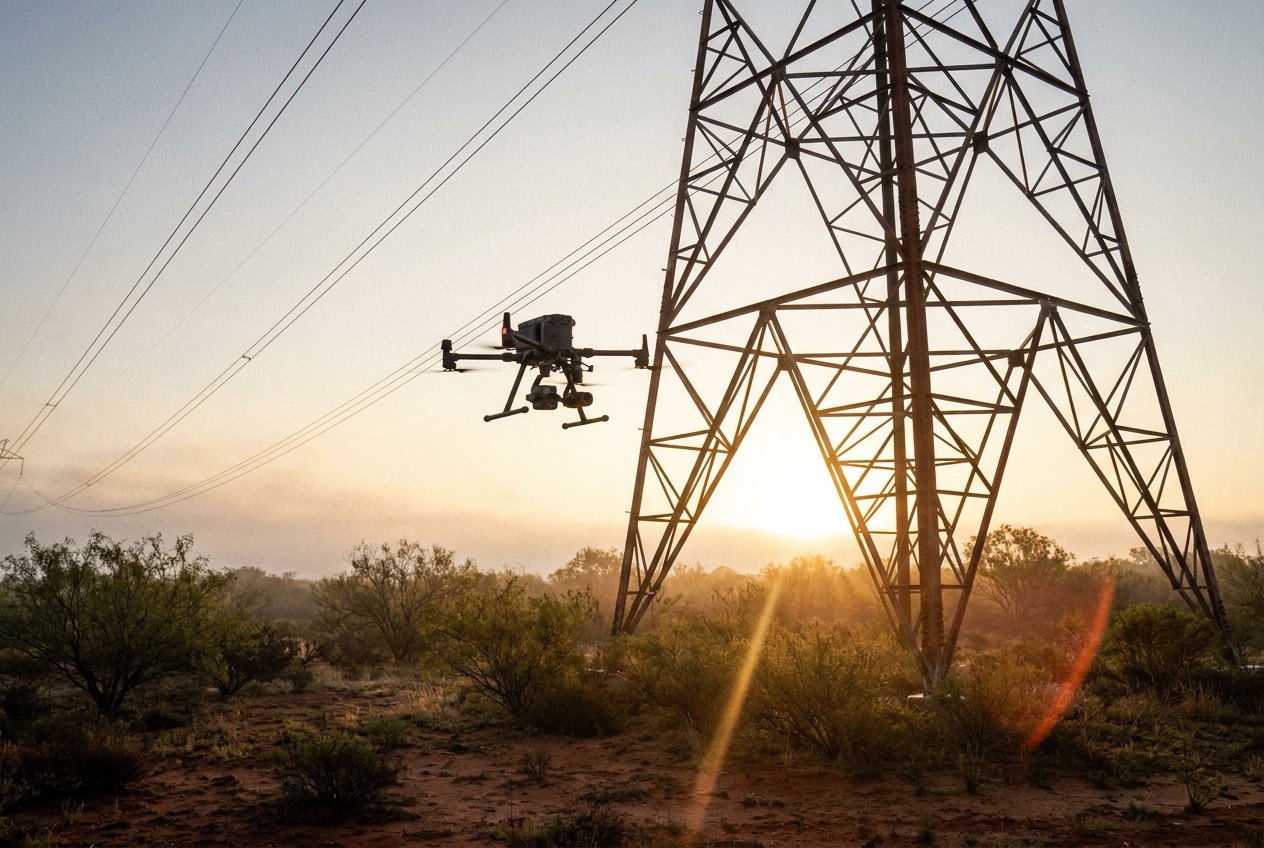
CAPROCK COUNTY, Tex., Oct. 10 — At 4 a.m., in a pasture with nobody in it, the lid of a steel box the size of a chest freezer folded back and a drone rose out of it. It climbed past the mesquite, turned north along the power line and went to work.
Caprock Electric Cooperative’s autonomous drones patrol the 1,900 miles of new transmission line serving the Mercy data center campus, docking every 12 miles in weatherproof nests to recharge.Caprock CountySeat: Mercy, pop. 3,912 (2020 census), about 70 miles southwest of Lubbock on the Llano Estacado. The county’s taxable value has risen from $410 million to $11.6 billion. They are the drones that serve the machines.
The campus, with 1.8 gigawatts energized today and 4.5 planned by 2028, makes some of its own power in 2.1 gigawatts of gas turbines owned by Gridline Energy, and draws more from the ERCOT grid over these lines.GRIDNYSE647⁄8▲21⁄4+3.6%Gridline Energy A town’s power lines get to rest at night. These do not. The machines at the end of them never sleep.
The drones fly beside the wires, well clear of them, photographing each tower, clamp and insulator with an ordinary camera and a thermal one. Software compares every picture with the last one taken from the same spot and flags whatever has changed. The dark helps: with no sun on the steel, a loose connection shows up on the thermal camera like a coal in a grate.
When a battery runs low, the drone drops into the next nest down the line. The lid closes over it, and the box charges it, cools it in August and warms it in January; the nests are built for hail and for the dust that blows across the caprock in spring. A drone already charged takes up the patrol where the last one left off.
Wade Tolliver, 49, the cooperative’s line superintendent, started out doing the same job from a pickup, with binoculars and a clipboard, one tower at a time. On a good day a crew might look closely at a few miles of line. There are 1,900 of them.
At 4:10 a.m. Tuesday, a drone working the line south of Mercy flagged a cracked insulator that Mr. Tolliver said would have taken a crew three days to find. InsulatorThe string of glass, porcelain or polymer discs — linemen call them bells — that holds a live conductor away from a steel tower. A cracked one can let current arc to the tower and knock the line out of service.“A crack you could cover with a hair, a hundred-some feet up, on one bell out of more than I could count,” Mr. Tolliver said. “It was on my phone when I woke up.” The alert came with a photograph, the tower’s number and its coordinates, which is more than a crew in a pickup ever had to go on.
The drones only find the trouble; people still go up and fix it. A crew replaced the string that afternoon, and the line never went dark.
By sunrise, the drone from the pasture was folded away in another nest 12 miles up the line, charging, and a fresh one had taken its place. Mr. Tolliver still drives out to some stretch of the line most weeks, he said, mostly to look at it. Asked whether he missed climbing towers, he laughed.
“My knees don’t,” he said.